
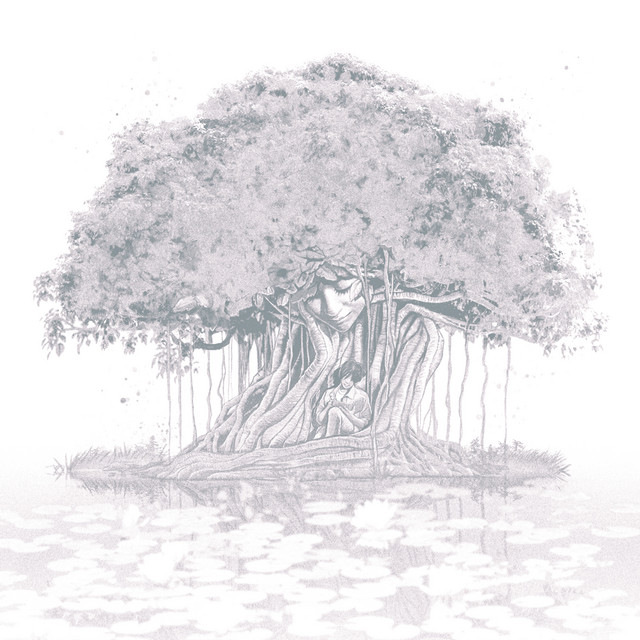
Bargad by sufr, Arpit Bala, and toorjo dey is a quietly devastating Hindi indie song that takes one of India's most familiar trees — the banyan — and makes it carry the full weight of roots, memory, and the fear of losing yourself as life pulls you forward. The song asks what it means to grow up and away without cutting free from where you came from. Here is what the title means, what the key lyrics are about, and why the song lands the way it does.
What Does "Bargad" Mean?
Bargad (बरगद) is the Hindi word for the banyan tree (Ficus benghalensis). If you know the tree, you know why it was chosen. The banyan grows differently from almost any other tree: it sends aerial roots downward from its branches, each of which thickens over time into a new trunk. A single banyan becomes a small, interconnected forest of trunks and roots — one organism that has expanded by repeatedly reaching down rather than out.
It is a tree that holds its ground across centuries. It does not uproot in storms. Village life in India has long gathered under its shade — panchayats, festivals, rest stops for travellers. The banyan appears in folklore, scripture, and proverb as a symbol of permanence, shelter, and the memory of many generations. By naming a song after it, the writers choose all of that weight as their frame.
Key Hindi Words in the Song
- Jad (जड़) — root. The song's central image, used to mean not just the roots of the tree but the roots of a person: origin, family, the ties that hold you to where you came from. "Apni jadon ko mat bhoolna" — don't forget your roots — is practically a proverb in Hindi; Bargad takes that familiar phrase and finds fresh grief in it.
- Chaaya (छाया) — shade, shelter. The banyan gives chaaya freely to everyone who passes under it. It does not choose who to protect. In the song, this generosity without condition becomes a model of love: the tree gives because that is what it is.
- Akela (अकेला) — alone, solitary. The bargad stands by itself in an open field or at the edge of a road, yet it is never empty — it is surrounded by those who have sheltered under it, who carry its memory even when they have moved on.
- Zindagi (ज़िंदगी) — life; the full span of experience, not a single moment. The song uses it to ask what it means to live without losing the thread back to what shaped you.
- Yaadein (यादें) — memories, plural of yaad. These are not pleasant nostalgia but something entangled — the song's image of memories caught in the branches suggests they are not easy to let go of or neatly filed away.
- Shakhein (शाखें) — branches, plural of shaakh. The banyan's branches are both spread wide (reaching, growing, going further) and the source of new roots. The song uses this double function: to grow outward and to keep reaching back down.
The Emotional Architecture of the Song
Bargad speaks most directly to the experience of being pulled between two things: the village and the city, the person you were and the person you are becoming, ambition and belonging. The bargad is the thing that stays while you leave. And somehow, that makes it a measure of how far you have gone.
What the song does well is refuse sentimentality. It does not say "go back." It does not say "leaving was wrong." It holds both realities at once: the city is where life is happening, and the bargad is still there, doing what it has always done — standing, sheltering, remembering. The emotional effect is not regret exactly; it is the peculiar sadness of loving something that cannot come with you.
There is also something in the image of the banyan's spreading roots that speaks to the way the past keeps reaching you. You think you have left your roots behind; the banyan's lesson is that roots go sideways, underground, in directions you did not plan. Origin catches up.
Why sufr, Arpit Bala, and toorjo dey?
The collaboration between sufr and Arpit Bala and toorjo dey sits in the space that Hindi indie music has carved out in the last several years — thoughtful, literary, not trying to be radio-ready or Bollywood-adjacent. Their work tends to be slow and specific, building atmosphere through accumulation rather than hooks. Bargad fits that approach: it earns its feeling through one sustained, extended metaphor rather than through emotional escalation.
The song was released in 2025 as a standalone track, which suits its mood. It is not background music. It is the kind of song you sit with.
A Note on the Existing Bargad Content
If you have been reading about the symbolism of the bargad tree in Indian culture, you may have found our earlier piece on the bargad as a symbol in Indian tradition. That post goes deeper into the cultural and religious significance of the banyan. This post is focused specifically on the song: its lyrics, the specific Hindi words it uses, and the emotional meaning it builds from the tree-as-metaphor.
Read the Full Lyrics & Translation
For the complete Hindi lyrics and their English translation line by line, visit the Bargad lyrics and translation page. The full text reveals how the writers move from the tree's concrete, physical details — deep roots, spreading branches, solitary standing — into the emotional territory of belonging and departure.
More Songs That Root You
The best Hindi indie songs reward close reading, and Bargad is among the most carefully made. For more of the vocabulary behind songs like this, read the guide to Hindi and Urdu words in Bollywood songs, and discover more translated lyrics in the lyrics library.