Ganesh Chaturthi 2026 falls on Monday, 14 September. The Chaturthi tithi begins at 7:06 am that morning and runs until 7:44 am on the 15th, which is why the sthapana — the installation of the murti — happens in the late morning of the 14th. The season ends with Anant Chaturdashi on Friday, 25 September, the day of the main visarjan.
Between those two dates there are ten evenings, and every one of them ends the same way: someone stands up, someone else fetches the lamp, and the house sings. This is a guide to what gets sung, in what order, and why the order is the way it is.
The sequence, in one line
In a Maharashtrian home the Ganesh aarti is not one song. It is three texts sung without a pause between them:
- Sukhkarta Dukhharta — Samarth Ramdas's Marathi aarti, the one the whole room knows.
- Shendur Lal Chadhayo — the Hindi aarti that follows it, usually without anyone announcing the change.
- Ghalin Lotangan — the closing shlokas of surrender, ending in the mahamantra and the shout of Ganpati Bappa Morya.
That is the whole ceremony. Ten minutes, three texts, one lamp going round. The pages linked above carry the complete Devanagari, a romanisation you can sing from, and what each verse means.
Why two aartis and not one
Sukhkarta Dukhharta is a portrait. Its verses describe the vermilion paste on his body, the pearl necklace, the jewelled crown, the anklets — a god standing still while the singer looks at him. It was written in the seventeenth century in a raga and a metre, and it is a composed piece of Marathi literature.
Shendur Lal Chadhayo is a different animal. It is in Hindi, not Marathi — chadhayo, biraje, moko, bhaave are Braj forms from north Indian devotional verse — and it is warmer and plainer. Its refrain asks for nothing except to keep looking: dhanya tumhare darshan, mera man ramta. Nobody is quite sure when a Hindi aarti became a fixed part of Marathi worship, but it has been in every printed Marathi aarti collection for as long as those have existed.
Singing both is not redundancy. The first one praises; the second one settles in.
The north Indian version of the same evening
Outside Maharashtra the sequence is shorter. Hindi-speaking families sing Jai Ganesh Jai Ganesh Deva — five short couplets that name his parents, describe his form, list what he gives, and end by asking him to keep the dignity of the poor — and then close with Om Jai Jagdish Hare, the universal aarti that ends almost any puja.
The third verse of Jai Ganesh Deva is worth knowing during Ganeshotsav specifically: ladduan ko bhog lage — laddoos are offered to him — followed by paan, flowers and dry fruit. It is a list of what is on the plate. The modak and the laddoo are not decoration; the text names them.
Morning and evening
Most homes with a sthapana murti do a short morning puja and a full evening aarti. The morning is quieter — a lamp, incense, often just Sukhkarta Dukhharta. The evening is the full sequence, with the family and anyone who has dropped in.
Households keeping Ganpati for the full ten days often add an aarti to a different deity on specific evenings — the goddess on the fifth day, for instance, when Gauri is installed alongside him in many Maharashtrian homes. The Ganesh sequence still opens and closes the evening; the other aarti sits in the middle.
Visarjan: which day, and the last aarti
Not every home keeps Ganpati for ten days. The common cycles for 2026 are:
- 1.5 days — visarjan on Tuesday, 15 September
- 3 days — Wednesday, 16 September
- 5 days — Friday, 18 September
- 7 days — Sunday, 20 September
- 10 days — Anant Chaturdashi, Friday, 25 September
Whichever day it is, the visarjan begins with a final aarti at home — the same three texts, sung more slowly than usual — and ends at the water with the last Ghalin Lotangan and the line everyone shouts: Ganpati Bappa Morya, pudhchya varshi lavkar ya — Ganpati Bappa, come early next year.
Between the aartis
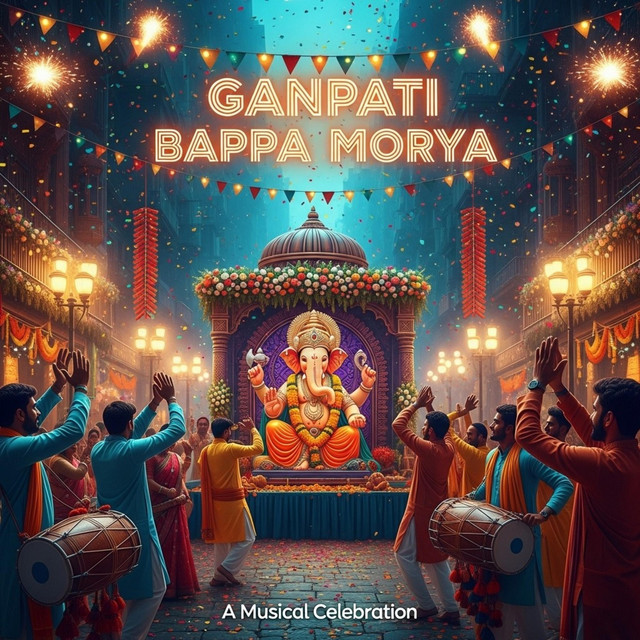
The aarti is ten minutes of the day. The rest of Ganeshotsav is music too, and a good deal of it is new. If you want a Ganpati song from this catalogue for the hours between the evening lamps, Ganpati Bappa Morya is an original written for exactly those ten days — you can read the lyrics or play it from that page.
All the aarti texts on this site are sourced from printed collections and cite the scan they were checked against. If your family sings a verse differently, you are probably not wrong: most of these texts have genuine variants, and each page lists the ones we know of.