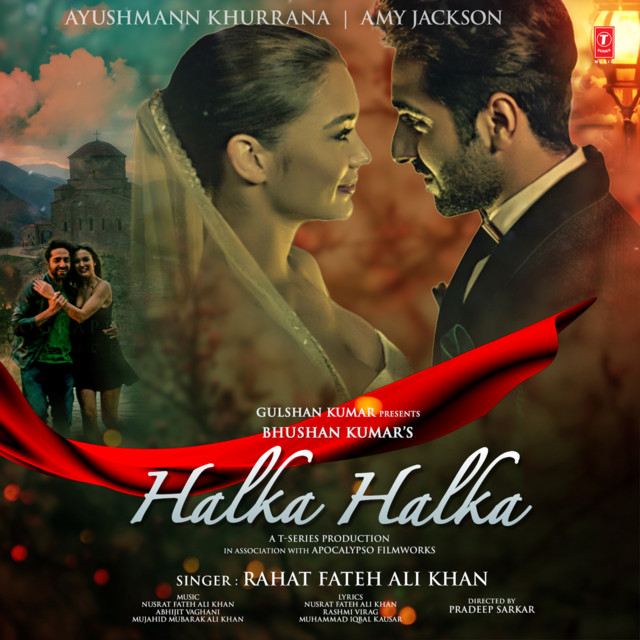
Halka Halka is a song about the early stages of love — the almost imperceptible moment when someone starts to settle into your thoughts and you realise, gradually, that something has changed. The title means lightly, softly, gently, and that description applies not just to the word but to the entire emotional texture of the track. Here is what Halka Halka means and why Rahat Fateh Ali Khan's voice makes it feel like something entering you by stealth.
What Does "Halka Halka" Mean?
Halka (हल्का) means light — in the sense of weight, not illumination. Something halka is feather-light, gentle, easy on the senses. Doubled as halka halka, the word becomes a description of sensation: not numbness, not intensity, but something softly suspended between the two. The song uses it to name the first flush of attraction — the barely-there intoxication of someone new entering your world.
Running alongside it is the word nasha — which means intoxication, a high, a stupor. So the phrase that the song orbits around carries something like "a light, gentle intoxication" — the kind you feel when you first become aware that someone has moved into the space behind your thoughts without asking permission.
Key Words to Know
Halka (हल्का): light, feathery, mild. The opposite of bhaari (heavy), both physically and emotionally. In this context it describes a feeling so delicate it might dissolve if you look at it too directly — the sensation of something arriving before you have named it.
Nasha (नशा): intoxication, a high. In Hindi and Urdu poetry, nasha is almost always metaphorical. The intoxication of love, of beauty, of eyes — it is a word with Sufi heritage. Mystic poets used it to describe the state of divine absorption, and Rahat Fateh Ali Khan, who carries the Qawwali tradition in his voice, uses it here in that same charged register.
Ehsaas (एहसास): feeling, awareness, sense. The word appears as a description of something the singer is only just beginning to become conscious of. It is the awareness itself, not yet the emotion fully formed — the moment before you can say what you feel.
Jaadu (जादू): magic, spell. The beloved's eyes are called jaadu — a magic that has been cast without any formal act of casting. It has simply happened, and the singer is already inside it.
The Sound and the Tradition
Rahat Fateh Ali Khan is one of the great inheritors of the Qawwali and Sufi devotional tradition of the subcontinent. When he sings halka halka, the word does not just mean gentle — it feels gentle. His voice has a quality of not pressing, of letting the emotion breathe and expand without rushing toward resolution.
The song blends that Sufi softness with contemporary pop production from composer Abhijit Vaghani, making it accessible to listeners who might not know Qawwali but can feel its emotional atmosphere. Lyricist Rashmi Virag writes in images that belong to the tradition — moonlit nights, the scent of the beloved on the wind, a connection the singer prays will never break — but in Rahat's delivery they feel freshly inhabited rather than borrowed.
The result is a track that works equally as a love song and as something slightly more meditative: a song about surrender rather than pursuit, about something that is happening to you rather than something you are doing.
When This Song Lands
Halka Halka is for the very earliest stages of love — before confession, before certainty, when something is beginning but you cannot yet name it. It is the song for the moment when someone's name appears too often in your thoughts, when their voice sounds different from everyone else's, when the world seems slightly more textured than it did before they arrived.
That specificity of feeling makes it enduringly popular. Most love songs deal with either the height of passion or the depths of heartbreak. Halka Halka stays in the softer, quieter zone that is often harder to write about — the beginning, before anything is decided, when the feeling is still halka enough to evaporate and yet somehow does not.
Released in late 2016, the song has a quality that resists being dated. The emotion it describes is perennial, the production is warm without being heavy, and Rahat's voice carries enough classical authority that the song feels rooted even when it is most modern.
The Sufi Thread
It is worth pausing on why Rahat Fateh Ali Khan — a Pakistani singer trained in classical music and the Qawwali tradition — became a beloved voice in Hindi film and independent music. Part of the answer is that the Sufi emotional vocabulary he inherited is perfectly suited to a certain kind of Hindi love song. Sufi poetry is fundamentally about longing: for the divine, for the beloved, for union with something greater than the self. When those themes meet a romantic lyric, the emotional charge is considerable.
Halka Halka sits in that tradition without being heavy about it. The devotional feeling is present but not explicit. The song feels spiritual in the way that any overwhelming emotion can feel spiritual — as if the person you have fallen for has opened something in you that was always there, waiting.
Read the Full Lyrics and Translation
To follow the imagery through the full song — the moonlit nights, the fragrant winds, the quiet prayer that the feeling will last — visit the Halka Halka lyrics and English meaning page for the complete Hindi lyrics and translation.
Words That Carry This Song
The vocabulary behind Halka Halka — nasha, ehsaas, jaadu, mohabbat — appears across dozens of beloved Hindi songs. Our guide to Hindi and Urdu words in Bollywood songs explains the meaning and history behind them, and our full lyrics library has more songs with meanings and translations.