Yeh Shaam Mastani is one of Kishore Kumar's most intoxicating performances — and the word mastani in the title is the key to understanding what the song does to a listener. Here is what Yeh Shaam Mastani means and why it has enchanted audiences since 1970.
What Does "Yeh Shaam Mastani" Mean?
Shaam means evening — specifically the blue-gold hour just after sunset, full of warmth and a faint, pleasant melancholy. In Hindi and Urdu poetry, shaam is a loaded word: it is when work stops, when the mind turns inward, when longing has room to breathe. The evening is the mood of the song before a single note plays.
Mastani is harder to translate in one word. It comes from mast — intoxicated, entranced, lost in delight — and mastani is its feminine form, meaning something or someone who is intoxicating by nature. In Urdu-Hindi poetry the word carries a proud, almost dangerous beauty: not something that tries to seduce but something that simply is seductive by existing.
So Yeh Shaam Mastani means this intoxicating evening — an evening so charged with romance that it makes you dizzy without wine, purely through the magic of the hour and the presence of the person beside you.
Key Words and Their Weight
Madhosh — this word appears immediately after mastani and deepens it. Madhosh means dazed, entranced, made senseless with joy or feeling. The evening does not merely please — it madhosh kiye jaaye, it keeps making you senseless, keeps spinning you around. The continuous tense matters: this is not a single moment of dizziness but an ongoing, irresistible undoing.
Suhaani — beautiful, pleasant, lovely, but with a softness that no single English word replicates. Suhaani raat (the beautiful night) arrives as the evening deepens, bringing chandni — moonlight — as its gift.
Chandni — moonlight, but in Bollywood poetry chandni means the kind of soft, silver light that makes everything romantic. It is not the harsh glare of the sun; it is the light under which confessions happen and promises are made.
Dilbar jaani — dilbar comes from dil (heart) + bar (holder/bearer), meaning "the one who carries my heart." Jaani is an intimate address — my life, my soul. Together dilbar jaani is a tender, slightly breathless address to the beloved: you who hold my heart, you who are my very life.
The Film, the Composer, the Voice
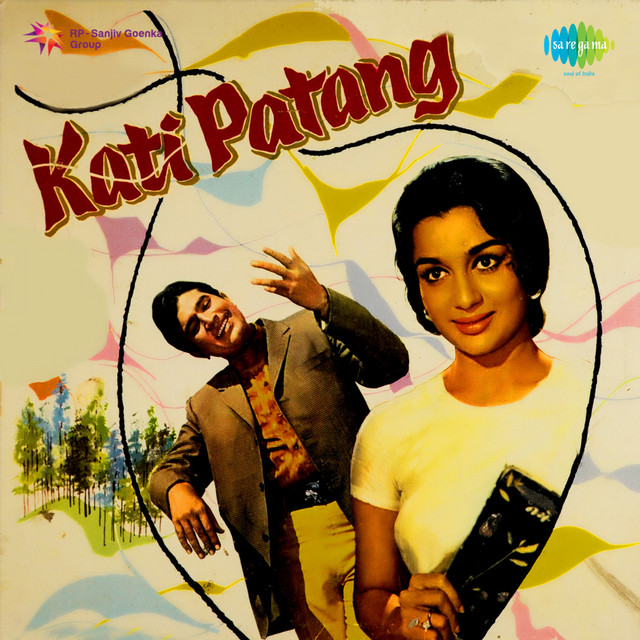
Yeh Shaam Mastani was composed by R. D. Burman and sung with effortless joy by Kishore Kumar for the 1970 film Kati Patang, directed by Shakti Samanta. The film starred Rajesh Khanna and Asha Parekh in a story involving hidden identity, grief, and love trying to find its footing again.
The song plays as a moment of pure, uncomplicated celebration inside a film that carries considerable emotional weight. That contrast — lightness inside a heavier story — is part of what makes it land with such force. The joy here is not naive; it is the joy that people who know sorrow allow themselves when something beautiful appears.
R. D. Burman's arrangement is a masterclass in orchestral playfulness: the strings dance, the brass punctuates, woodwinds curl around the melody. Kishore Kumar sounds as though he is discovering the evening's magic in real time rather than performing a scripted emotion. That spontaneity — the sense that the singer is actually dizzy with this feeling right now — is still fully audible more than five decades later.
Why It Has Outlasted Its Era
Yeh Shaam Mastani has outlived its film, its decade, and several generations of Bollywood. It appears in playlists made by people who have never watched a 1970s Hindi film. It gets covered, sampled, and sung at family gatherings where the youngest person in the room was born forty years after its release.
The reason is simple: the emotion it captures — the euphoria of an ordinary evening turned magical by love — is not period-specific. That feeling exists whenever it exists. Kishore Kumar does not date it by how he delivers it; if anything, the relaxed warmth of his voice makes it sound more timeless than technically polished later recordings.
For anyone learning to understand classic Hindi film music, this song is one of the cleanest entry points to the golden-era sound. The words are clear, the images are vivid, and the feeling is immediate. You do not need to know the film. You just need to have had an evening like this, or wanted one.
Read the Full Lyrics and Translation
For the complete original lyrics, a line-by-line English translation, and a deeper breakdown of the imagery, visit the Yeh Shaam Mastani lyrics and meaning page. Listening while reading makes the shimmer of Kishore Kumar's phrasing fully visible.
Explore More Hindi Song Meanings
For the vocabulary of classic Hindi love songs — shaam, mastani, dilbar, chandni, madhosh — see our guide to Hindi and Urdu words in Bollywood songs. For more meanings and translations across eras and genres, browse the full lyrics library.