Diwali 2026 falls on Sunday 8 November. The Lakshmi puja muhurat in most cities runs from around 5:30 PM to 7:30 PM. After that, the evening opens: firecrackers outside, diyas in every window, and in millions of households across India, a deck of cards on the table.
The taash party is one of the more honest Indian traditions. It is gambling, but it is gambling that has been absorbed into the festival structure so completely that a household that does not play on Diwali night is making a social choice. The card table is where aunts and cousins who have not spoken since Holi sit across from each other. It is where the year-old argument about the property gets silently filed away for another year. And after midnight, when the serious players are still at it, someone will have cleared space and the music will have taken over the room. Here is the playlist for that night, drawn from songs I have written and recorded as Married Moonda.
After puja: the room fills
The transition from the Lakshmi puja into the party is not a clean line. The incense is still in the air, the floor has rangoli on it, and people are arriving in new clothes. The music needs to acknowledge that the sacred hour has just passed without pretending the evening is still in it.
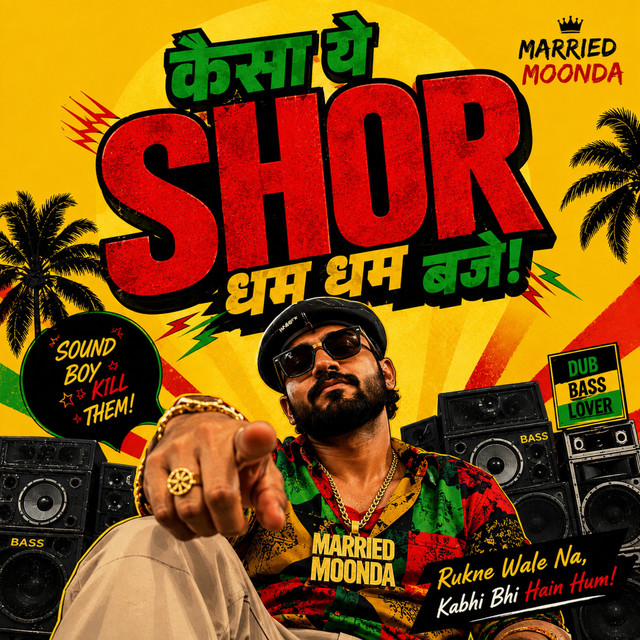
Kaisa Ye Shor Dham Dham Baje is the opening track for this. The title is the question it answers: what is this noise, pounding dham dham. The hook is a dhol beat written as a word — dham dham baje — with the crowd answering dham dham. It opens with a name-check and a call to attention, and everything after is call-and-response. Two short verses about walking with your chest out and not getting caught in talk, over a drum that does not stop. This is the catalogue's closest thing to a procession or crowd anthem — built specifically to announce that the noise has started and is not going to stop.
The card table: two in and things get interesting
Once the cards are dealt and the first round of losses starts to sting, the room settles into a different energy — competitive, sharp, and funnier than it was twenty minutes ago. The playlist here should match that.
Sab Chahiye is a confidence anthem from a woman's point of view, built almost entirely as a list of contradicting similes: fast as a cheetah, fierce as a lion, cold as the moon and hot as the sun in the same sentence. The pairs contradict each other on purpose, because the singer is refusing to pick one version of herself. The thesis arrives plainly: I want all of it, nothing less, every season will show itself in me. Then the hook tightens it: sab chahiye, bas abhi, abhi yahin — all of it, right now, right here. At a card table on Diwali night, anyone who has just picked up a good hand will hear this differently.
The Bollywood card-game canon is largely from Shahrukh Khan films, and it does its job. Luck By Chance (title track) and various Casino song sequences bring a filmy glamour to the table. But the energy of a real household card game is less glamour and more comfortable chaos, which is where this list lives.
The floor clears for dancing
At some point — usually after midnight, usually after the third round of snacks — the cards go away and the room becomes a floor. This transition is not planned, it just happens, and when it does the music needs to be ready.
Matka Patka Latka is built for exactly this. The title is three rhyming words that describe a dance rather than tell a story — the hip-swing, the slam, the dangling swaying move — strung together because the way they sound is the entire point. The subtitle is the brief: non-stop party. At 3:40, it is sized for a floor. It is not the song for the background; it is the song for when the background is over.
The drinks table
Not every Diwali household is a dry Diwali household. In urban apartments and mixed-company gatherings, the drinks table opens around the same time as the card table. The playlist for that corner of the room has a specific character: it should be funny, comfortable, and completely unbothered.
Mujhe Sharaab Chahiye is a comedy record about losing your drink and needing it back. The narrator has arrived drunk, everything is fine, and then the sharaab goes missing. He searches from morning to night. He dreams about it. The conclusion: whether winning or losing, whether happy or sad, he needs it regardless. It is a party song wearing the disguise of a longing number — deadpan, short, and impossible to take seriously, which is the right register for a Diwali night that has reached the stage where nobody is going home.
On building the night in phases
A Diwali card night has three distinct phases, and they want three different registers.
The first phase — the hour after puja, before the cards start in earnest — wants announcement energy. Something that says the night has started. Kaisa Ye Shor for this.
The second phase — the serious card playing, the competitive hour — wants music that has confidence in it without demanding attention. The songs that let people win and lose with a grin. Sab Chahiye and Matka Patka for this.
The third phase — after midnight, when the cards are cleared and nobody wants to go home — wants the floor. Whatever is left of the Bollywood party tracks, whatever else is in the queue. The session we have are the songs that do not outstay their welcome.
The full list in order
For Diwali card night 2026:
- Kaisa Ye Shor Dham Dham Baje — after puja, the room fills
- Sab Chahiye — the card table, competitive hour
- Matka Patka Latka — the floor
- Mujhe Sharaab Chahiye — the drinks table, no agenda
The full party and dance catalogue is at the party and dance anthems hub.
Frequently asked questions
When is Diwali in 2026? Diwali 2026 is on Sunday 8 November. The Lakshmi puja muhurat varies by city; in Delhi it falls in the 5:30 PM to 7:30 PM range. Choti Diwali is Saturday 7 November and Dhanteras is Friday 6 November.
Why do people play cards on Diwali? The tradition comes from the story that Parvati decreed whoever played dice on Diwali night would prosper through the year. Gambling on this one night is considered auspicious, and the taash game is a social institution as much as a religious one — it brings the household and neighbours together in a way that the puja itself, being more private, does not.
What music do people play at Diwali parties? Bollywood's party catalogue is the default — DJ Wale Babu (Badshah), Kar Gayi Chull (Badshah), and older classics like Dardi Rab Rab all get played. In more mixed-age settings, devotional and soft songs run alongside the party tracks. The independent and indie Hindi space has been thin on Diwali party music; the songs above are from that gap.
Written by Anup Karanjkar — Married Moonda.
Sources: Diwali 2026 date and Lakshmi puja muhurat — October 2026 Hindu festivals calendar — Hindutone · Dhanteras and Diwali 2026 dates — HappyFares