Dussehra 2026 falls on Tuesday 20 October. The Vijay Muhurat — the auspicious window for new beginnings — sits between 2:00 PM and 2:46 PM IST. By then, Ram Lila performances across the country are reaching their final act, and by evening the forty-foot Ravan effigy is going up in smoke in every major city. It is one of the few days in the Indian calendar with a clear structure: morning puja, afternoon performance, evening fire, and then the quiet of a victory that has just been confirmed for the ten-thousandth year in a row.
That structure is worth building a playlist around. The music that fits the Shami puja at 9am does not fit the dahan at 7pm, and neither fits the drive home after. Here is how I would sequence motivational and energetic Hindi songs across Vijayadashami, drawing on the songs I have written and recorded as Married Moonda.
Morning: the Shami puja and the march
The Shami tree puja takes place before noon in most households — a brief ritual, the mood settled rather than excited. Ram has already won. This is the acknowledgment, not the anticipation.
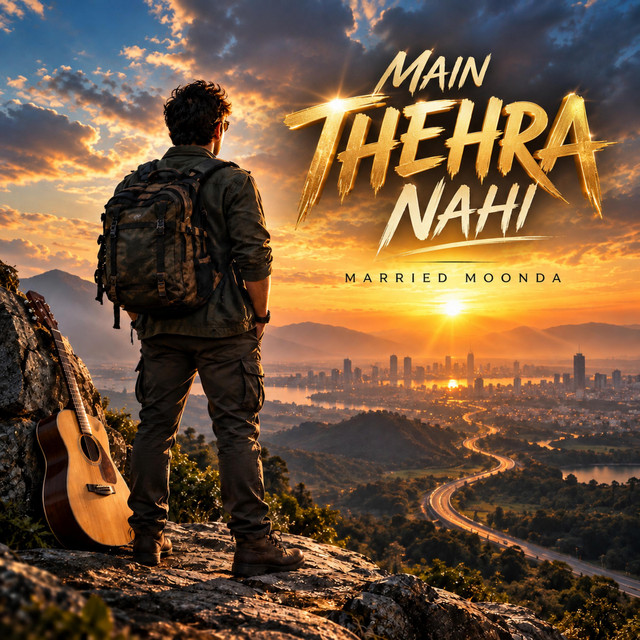
Main Tehra Nahi is about the cost of continuing when everything argued for stopping. The sunlight still says run again, sleep has become cheap, the people who mattered most made you cry — and the refrain is just four flat denials: I did not stop, I did not break, I did not bow, I never stepped off my path. The best image is the water metaphor: the waves themselves are now saying how deep the water is — the work speaks before the narrator has to. It is a quiet, earned kind of victory. Dussehra morning is the same register: not the excitement of a fight, but the acknowledgment of one already won.
For a devotional start to the day, the Hanuman Lala Ki Aarti text — Devanagari, romanisation, and line meanings — is at mygeetaibeat.com. Hanuman is Ram's closest ally, and his aarti fits naturally at the opening of Vijayadashami.
The Ramlila afternoon
Ramlila performances reach their climax in the afternoon: the final battle, Lanka burning, Ram's return. The crowd knows every word and watches anyway, which is the point. A story you already know, still worth hearing again, because the knowing is not the same as the certainty it will end right.
Main Ab Bhi Zinda Hoon opens on a correction: the story never ended, people just assumed it had. The verses are specific about hardship in a way survival anthems usually avoid — the floor was the bed, the pocket was empty but the pain always came in cash. The pivot is the line about falling: if I fell, so what — the ground taught me to walk. The song is not about other people's doubt; it is about the specific loneliness that forces a person to become someone new. The Ramlila parallel is there if you want it, and if you do not, the song still holds.
Bollywood has its own vocabulary for this afternoon. The battle sequences from Bajrangi Bhaijaan and the Ram Stuti arrangements that have played at Ram Lila grounds for thirty years do their job in a crowd. Independent tracks serve the gaps between the public events — the car ride, the waiting, the quiet before the main gathering.
Ravan dahan: the effigy and the fire
The effigy goes up between six and eight in most cities. This is the loud, public, fire-and-cracker event of the year, and it wants music that has some chest in it.
Raakh Se Utthaa is structured in two halves, and the seam between them is the design. The first half refuses to recover: heavy breaths, an empty heartbeat, a betrayal named directly — a dagger behind the back, false promises. The cruellest line is not about the other person at all: you made me fall in my own eyes. Then the break arrives. Enough. Wake up. The chorus carries the image — memories set on fire, words turned to smoke — and the title pays it off: he rises from that ash as a flame. Raakh means ash. The timing is not accidental.
After the fire: the evening of new beginnings
Once the crowd disperses, the real Dussehra evening starts. People visit family, exchange sweets, set new accounts in the ledger. There is an old tradition of beginning things on Vijayadashami — signing a lease, buying a vehicle, starting a new chapter — built on the belief that what you begin here will succeed.
Apna Daur Hai Aaya is a victory lap that keeps pointing back to the work behind it. Daur means an era or a turn — my time has come — and the song spends its length arguing that the turn was worked for rather than granted. The most honest couplet is the modest one: no taste for showing off, we just do our work; plain people, we fear only God. That line sits oddly next to the long car and the big projects in the same verse, and the contradiction is genuine — this is what earned success actually sounds like, proud of the car and anxious to be seen as unchanged by it. The song is addressed less to doubters than to the people who stayed.
Why this register, why today
Dussehra carries a particular kind of victory — not the chaotic rush of a last-minute win, but the settled confirmation of something that was already true. Ram did not wonder whether he would prevail. He already knew what was right. He just had to do it.
The songs I have selected for today share that quality. They are not hype tracks. They are accounts of someone who kept going when continuing was genuinely hard, and who is now on the other side of it. That is the shape of Vijayadashami: not the excitement of the battle, but the clean air after.
The full list in sequence
For Dussehra 2026, in order:
- Main Tehra Nahi — morning, before and after Shami puja
- Main Ab Bhi Zinda Hoon — Ramlila afternoon
- Raakh Se Utthaa — the dahan hour
- Apna Daur Hai Aaya — the quiet victory after
The wider catalogue of motivation and attitude songs — grind tracks, comeback tracks, and the ones about continuing when it would be easier to stop — is at the attitude and motivation hub.
Frequently asked questions
When is Dussehra in 2026? Dussehra / Vijayadashami 2026 is on Tuesday 20 October. The Vijay Muhurat is from 2:00 PM to 2:46 PM IST, the window considered auspicious for starting new ventures.
What is the difference between Dussehra and Vijayadashami? Vijayadashami — "the tenth day of victory" — is the broader name used across India, particularly in South India and Maharashtra. Dussehra is more common in North India and specifically refers to the burning of Ravan's effigy. Both mark the same day and the same defeat of evil.
What songs are played at Ravan dahan? There is no standard track the way there is for a wedding baraat. Dhol and devotional procession music is common in the lead-up; once the effigy is lit, the crowd is usually making enough noise on its own that the music is secondary. If you are building a playlist for the drive to the ground, pick something with some force to it — this is not the occasion for background music.
Written by Anup Karanjkar — Married Moonda.
Sources: Dussehra 2026 date and Vijay Muhurat — SmartPuja · Vijayadashami 2026 complete guide — Hindutone · Dussehra 2026 — DekhoP anchang