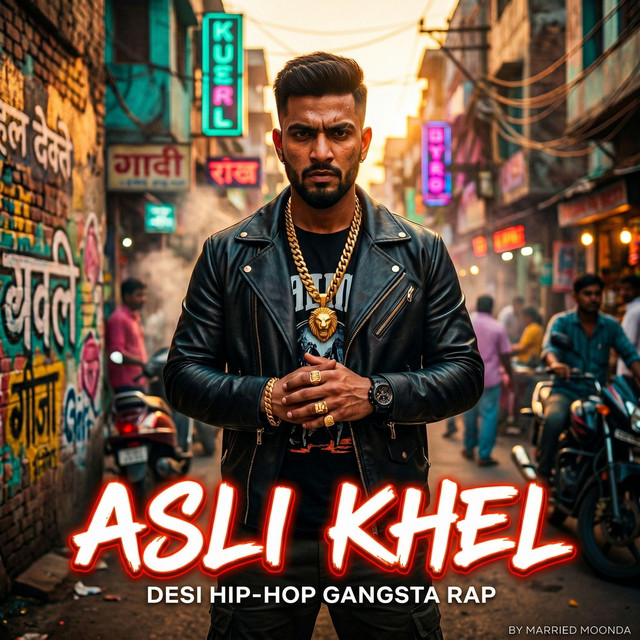
Asli Khel lyrics meaning — Married Moonda's April 2026 Hindi rap single announces its premise in the title and then spends seven verses earning it. The song is about self-made authority on the streets: how it feels from inside, what keeps it standing, and what happens to anyone who tests it. The full lyrics and line-by-line English translation are on the dedicated lyrics page; this post goes through what the words are doing and why they land the way they do.
What "Asli Khel" means
In Hindi, asli means real, genuine, or original. Khel means game or play. The compound phrase asli khel — the real game — carries a specific implication: there is a fake version of this, and what is described here is not that. Posturing, borrowed swagger, performance without substance — those are what the narrator is positioned against throughout the song.
The chorus reinforces this with the phrase koi bachchon ka na kaam — not child's work. That framing separates what the narrator is doing from every diluted or performative version of the same terrain. The real game has actual stakes, actual consequences, and it demands something that cannot be faked.
How the song opens: voice, streets, and no sleep for rivals
The first verse addresses someone directly: sun le chhote, baat meri pate ki — listen, kid, what I am about to say is worth knowing. The register is a specific one in Hindi rap — an experienced voice addressing someone who has not yet arrived at the place being described. The claim that follows is that the narrator's reputation moves through the streets and that they have already taken sleep from people who assumed they had a secure position.
Paisa, power, rutba, yahi apna scene hai — money, power, standing, that is the situation. The line does not argue or explain the acquisition of these things; it states them as current fact and moves on. The second verse adds the internal dimension: aankhon mein aag, aur baaton mein hai swag — fire in the eyes, swagger in the words. What the song values is the match between what shows on the outside and what is actually present on the inside.
The foil set up in the second verse is equally precise. People who bark loudly from behind and fall quiet when you face them directly are exactly what authentic positioning is not. The contrast is never named abstractly; it shows up as behaviour.
The chorus and the cost of not bowing
The chorus arrives without preamble: ye hai asli khel, koi bachchon ka na kaam. This is the real game, not child's play. Then the spread of that reputation: har sadak pe chalta hai ab apna hi naam — now my name travels down every street. The next two lines are where the chorus carries its real weight: smoke in the air, courage in the chest, and a head that will not bow regardless of how much pressure accumulates.
Jhukta nahi sar, chahe jitne hon sitam is the line the chorus is built around. In Hindi, bowing the head carries social charge beyond its literal meaning; it signals acknowledged subordination, deference, a hierarchy accepted. The refusal is therefore more than confidence — it is a specific rejection of a particular social performance. The narrator will not act subordinate even under accumulated hardship.
The chorus repeats exactly later in the song. The second time it lands differently because two more verses have shown what maintaining that posture actually requires of a person.
Loyalty, the system, and the enemy count
The third and fourth verses open two further themes. The first is group loyalty. Sheron ki basti mein, hum hain asli aulaad — in the land of lions, we are the true heirs. The word aulaad — offspring, heirs — gives this a lineage weight that goes beyond positional claim. They belong to this place in a way that cannot be transferred or imitated. The crew is real and the rules that govern it are real.
The fourth verse turns to the system itself and claims it has been brought under the narrator's own control. The line does not elaborate on how, and it does not need to. What matters is the one that follows: jeete hain shaan se, na marte udhaari pe — we live with dignity, we do not die in debt. Debt here means dependency on someone else's goodwill or permission to exist in a particular space.
The fifth verse introduces the adversary count, which has now exceeded any tally. The image that carries it is one of the sharpest in the song: guns that are silent, but eyes that already hold the trigger. The violence is present as potential rather than action, and that is precisely where the pressure of the line lives.
The Psydelic Mix and the upcoming official music video
"Asli Khel | Original" was released on 25 April 2026 as part of a two-track single called Asli khel. The second track is the Asli Khel Psydelic Mix, which takes the same words into a different sonic arrangement. The original is the vocal-forward hip-hop cut; the Psydelic Mix reworks the production around a different texture while keeping the lyrics unchanged.
A lyric video putting the Hindi text against the track's tempo is already live on the My Geet AI Beats channel — watch it here. The official music video premieres on the My Geet AI Beats YouTube channel on Sunday 1 November 2026 at 7 pm IST.
The complete lyrics and English translation are on the lyrics page, and the track is on Spotify. For other Hindi rap and desi trap tracks in the catalogue, Nabbe Hazar Ke Joote and PB11 KING — A Desi Trap Anthem cover related ground. The new Hindi indie songs October 2026 roundup includes further context on recent releases from this catalogue.
Frequently asked questions
What does "Asli Khel" mean in Hindi? Asli means real or genuine, and khel means game. Together, asli khel translates to "the real game" — the serious, high-stakes situation as distinct from performance or pretense. In the song it separates what the narrator has genuinely earned from what others merely claim or imitate.
What is on the "Asli khel" release? The release contains two tracks: "Asli Khel | Original," the hip-hop version, and the Psydelic Mix, which reworks the same lyrics in a different arrangement. Both were put out together on 25 April 2026 by Married Moonda on Spotify and the major streaming platforms.
When does the official music video come out? The official music video for "Asli Khel | Original" premieres on the My Geet AI Beats YouTube channel on Sunday 1 November 2026 at 7 pm IST. A lyric video with the Hindi text on screen is already available on the channel.
Written by Anup Karanjkar — Married Moonda.