Dev Uthani Ekadashi 2026 falls on Friday 20 November (Smarta tradition) or Saturday 21 November (Vaishnava observance), depending on which panchang your family follows — both SmartPuja and Daanyam agree that the Ekadashi tithi lands on November 20, with the Vaishnava observance extended a day. It is the morning Vishnu wakes from his four-month slumber during Chaturmas, and from this day the suspension on auspicious ceremonies — including weddings — lifts. The first vivah muhurats appear almost immediately: November 21, then 24, 25, and 26, per SmartPuja's muhurat calendar. December brings a dense cluster on the 2nd, 3rd, 4th, 5th, and 6th, with two more on the 11th and 12th. SmartPuja's calendar lists no vivah muhurats in August, September or October 2026, so that late-November opening arrives suddenly after a long dry stretch.
Every household with a booking to confirm is already counting the days. That compressed six-week sprint from late November through mid-December is when most North Indian and Maharashtrian weddings land.
We have been asked which of our songs fit the rituals. The honest answer is that some do and some do not. Haldi and mehndi are specific enough that nothing in the current catalog fits them without a stretch, so those two rituals are not here. What follows covers five rituals where the connection is genuine.
Sangeet: the night for dancing
The sangeet is the only ritual that exists explicitly to make the floor move. Two songs from the catalog are built for it.
Chintu Ki Shadi puts you inside the wedding rather than outside it. The dulha is flustered by the dulhan's entry, the saalon have commandeered the dance floor, the pandit is working through mantras amid the noise. The opening line is a literal roll call: "khaane se lekar naachne tak sabki hai duty" — everyone from the caterers to the cousins has a job. The track explicitly names joota chhupana as the saalon's one assigned task, which gives it a second use later in the evening. It is the only song in the catalog that locates you at a specific wedding event rather than describing how someone feels about love in general.
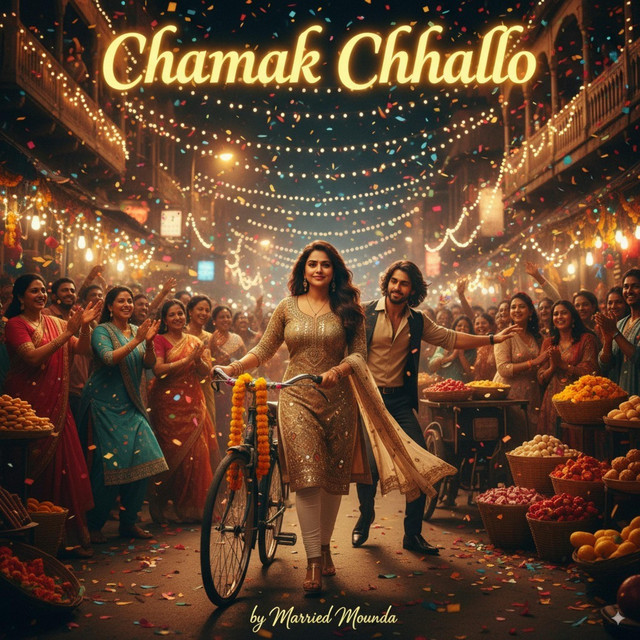
Chamak Chhallo is about what happens when someone arrives and rearranges the room. The lyric "Sadak pe utri jaise koi Superstar / har nigaah bole ye to meri wali hai yaar" — she walked in like a celebrity and every pair of eyes said that's my person — captures the sangeet's particular dynamic: one entrance, the whole floor reconfiguring. The energy is playful without being loud about it.
Baraat: the procession
A baraat needs music that requires nothing from the listener. No one dancing on a truck at ten in the morning is waiting to decode a verse.
Matka Patka Latka | Non Stop Party is named after three dance moves rather than a story. Matka is the folk-dance hip-swing, patka is a hard slap-and-drop, latka a swinging, swaying motion — strung together they describe a body in action, not a sentiment. The subtitle states the contract: non-stop party. The production is EDM, tagged energetic and upbeat, and it runs 3:40, which is the right length for a procession that does not stop. There is no story to follow, which is exactly the point.
Joota churai: the shoe game
The ritual the bride's family enjoys most and the groom endures. The saalis take his shoes; he negotiates. The more expensive the shoes, the better the game.
Nabbe Hazar Ke Joote opens on the exact contradiction: "Nabbe hazaar ke joote hain, par chalta main wahi road pe." Ninety-thousand-rupee shoes, same old street. The entire song is built on that gap between the price tag and the ground underneath — success has arrived; nothing fundamental has changed. At a joota churai, the song becomes a running commentary that everyone in the mandap can hear. The bride's family is welcome to use it as their negotiating soundtrack.
Jaimala: the first glance
The jaimala is when the couple formally faces each other — garlands exchanged, photographs begun, the crowd briefly hysterical. Whatever the groom is experiencing in that moment is what Pahli Nazar Ka Jadoo is about.
"Pehli baar jab tumko dekha, dil mein baji ek ghanti / Life jo thi black and white, ho gayi suddenly ulti." A bell rings, the world inverts from grey to colour. The song does not build to that image — it opens with it and spends the rest of its runtime on the body trying to catch up with what the eyes registered in a single second. The register is romantic in the most immediate sense: no backstory, no shared history, just the first contact.
Vidaai: the farewell
The vidaai splits the emotional weight between those leaving and those receiving. A song that holds only loss is too heavy; a song that is only celebratory misses what is actually happening. The right register is transformation.
Ek Teri Muskaan opens on exactly that: "Kal tak jo dhoop thi, ab chaandni si lagti hai." What was once flat sunlight now feels like moonlight. The song is about how one person's presence changes the quality of ordinary things — words that were dry, silences that were empty, directions a day moves. For the groom's family receiving someone new into the house, and for the couple stepping into the ordinary life that follows the ceremony, this is the right note. The mood is emotional without asking anyone to grieve.
The full list, in order
- Chintu Ki Shadi — sangeet
- Chamak Chhallo — sangeet
- Matka Patka Latka | Non Stop Party — baraat
- Nabbe Hazar Ke Joote — joota churai
- Pahli Nazar Ka Jadoo — jaimala
- Ek Teri Muskaan — vidaai
More songs in the energetic and romantic mood categories are available if you want to build these into a longer playlist.
Frequently asked questions
When does the 2026 Indian wedding season officially begin? Dev Uthani Ekadashi — also called Prabodhini or Devutthana Ekadashi — marks the end of Chaturmas and the resumption of auspicious ceremonies. In 2026 it falls on Friday 20 November (Smarta observance) or Saturday 21 November (Vaishnava), according to SmartPuja and Daanyam, both of which give Delhi-region times; check your family's panchang for your city. The first vivah muhurats on SmartPuja's list are November 21, 24, 25, and 26, followed by December 2, 3, 4, 5, and 6. The season continues into early 2027.
Why are haldi and mehndi missing from this list? We checked the catalog and found no song that is specifically about haldi, turmeric, or a mehndi night. Rather than force a match, we left those rituals out. If a song comes along that genuinely fits either ceremony, this post will be updated.
Can I play these songs at an actual wedding? Yes. All six are on Spotify and other streaming platforms under Married Moonda. For public performance at a venue, standard PPL licensing applies — the venue's blanket licence covers it in most cases. For home ceremonies and private family events, you are free to stream them as you would any other track.
Is this only for North Indian weddings? The rituals named here — sangeet, baraat, joota churai, jaimala, vidaai — appear across North Indian and many Maharashtrian wedding traditions. The song catalog is built on Hindi and occasional Marathi, so it sits comfortably in both contexts. Telugu, Tamil, and Kannada weddings have different ritual structures; the list above would need a different set of songs to match those.
Written by Anup Karanjkar — Married Moonda.
Sources: Devuthani Ekadashi 2026 date and Chaturmas — Daanyam · Vivah Muhurat 2026 auspicious dates — SmartPuja · Devutthana Ekadashi 2026 vrat — SmartPuja